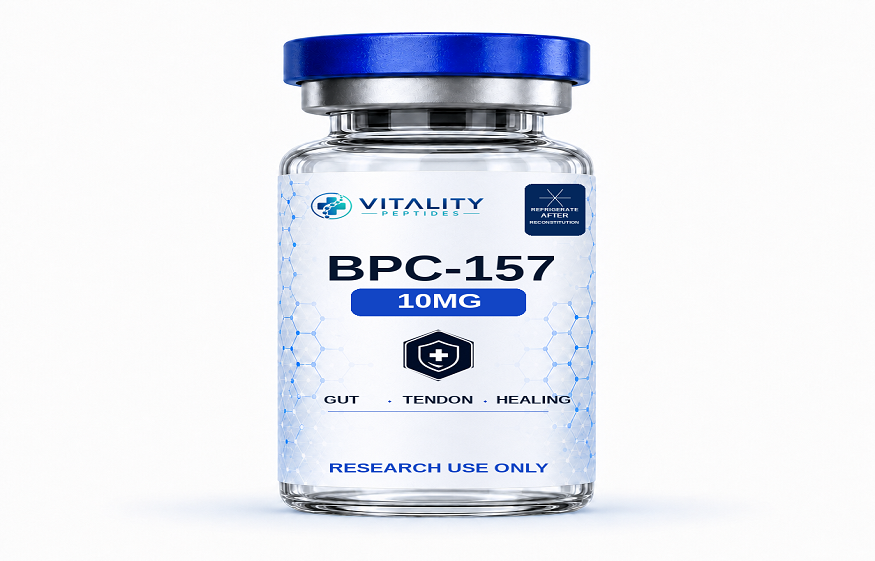

BPC-157 is an area of interest in sports science. Researchers have studied its potential for a number of sports-related tissue repair and neurological recovery areas.
The majority of the evidence currently available is from laboratory studies and work on animals. But the spectrum of research areas makes the peptide an interesting research area for those interested in sports-related injuries.
Soft tissue repair
One of the most studied areas is the repair of soft tissues such as:
- Tendons
- Ligaments
- Skeletal muscle.
Researchers have investigated the effect of BPC-157 peptides on a variety of tissue regeneration processes, such as:
- Fibroblast activity
- Collagen production
- Angiogenesis
- Cellular migration.
Experimental studies have reported enhanced healing in several models involving:
- Tendon
- Ligament
- Muscle injuries.
These tissues may be poorly vascularized. Thereby making regeneration a complex biological process. The available evidence is mostly preclinical, and these results need to be confirmed in humans.
Fracture healing
Another area of interest is the repair of bones. Researchers have investigated BPC-157 peptidesin experimental fracture models, including situations where normal healing may be compromised.
The peptide has been studied with respect to its potential effects on:
- Bone formation
- Vascularization
- Cellular activity during fracture consolidation.
The relationship between bloodvessel formation and bone regeneration is especially pertinent.
Improvements in fracture healing have been reported in preclinical studies. But they should not be taken as proof of a treatment for human fractures.
Read More: How a Chiropractor in Hickory Can Improve Your Sleep and Overall Wellness
Reduced fibrosis
The other research question is related to fibrosis or overproduction of scar tissue during the healing process. Scars are a natural part of the healing process. But if it’s too much, it can affect the normal structure and function of the repaired tissue.
Research has been conducted on BPC-157 for its potential to affect inflammatory and cellular pathways in fibrosis. Research on injured muscle has documented changes in fibrosis and tissue recovery.
Researchers are exploring whether it is possible to control excessive fibrotic responses to achieve better structural recovery.
Bone-to-tendon junctions
Tissue boundaries can be difficult to investigate. At bone-to-tendon junctions, for instance, transitional tissue links structures with different mechanical and biological characteristics.
Researchers have investigated BPC-157 in osteotendinous and other junctional injury models. Recent reviews describe experimental results on:
- Tendon-to-bone healing
- Muscle-to-tendon healing
- Muscle-to-bone healing.
These studies are important because they show that the injuries at the junctions must be repaired in a coordinated way, not just the tissue that has been injured.
Cellular mechanisms
The researchers are also exploring the biological effects of BPC-157 in experimental models. A suggested mechanism is through the action of VEGFR2 signaling. It is linked to angiogenesis and vascular repair.
Other studies have examined effects on fibroblast and tenocyte activity, and pathways involving:
- Nitric oxide
- Akt
- eNOS.
Understanding these cellular mechanisms is crucial. It lets researchers go beyond observing whether injured tissue improves. It also lets them explore what might be causing specific changes.
Read More: The Hassle-Free Way to Enjoy Crisp, Clean Spring Water
Summing up
BPC-157 research in sports science is far more than just muscle recovery. Ongoing research explores:
- Soft tissue healing
- Fracture healing
- Fibrosis
- Complex bone-to-tendon interface
- Cellular signalling
- Neurological recovery.
Most of the studies are, however, preliminary and conducted in animals. Larger controlled human studies are required to make a definitive statement about clinical effectiveness.